Follow Us


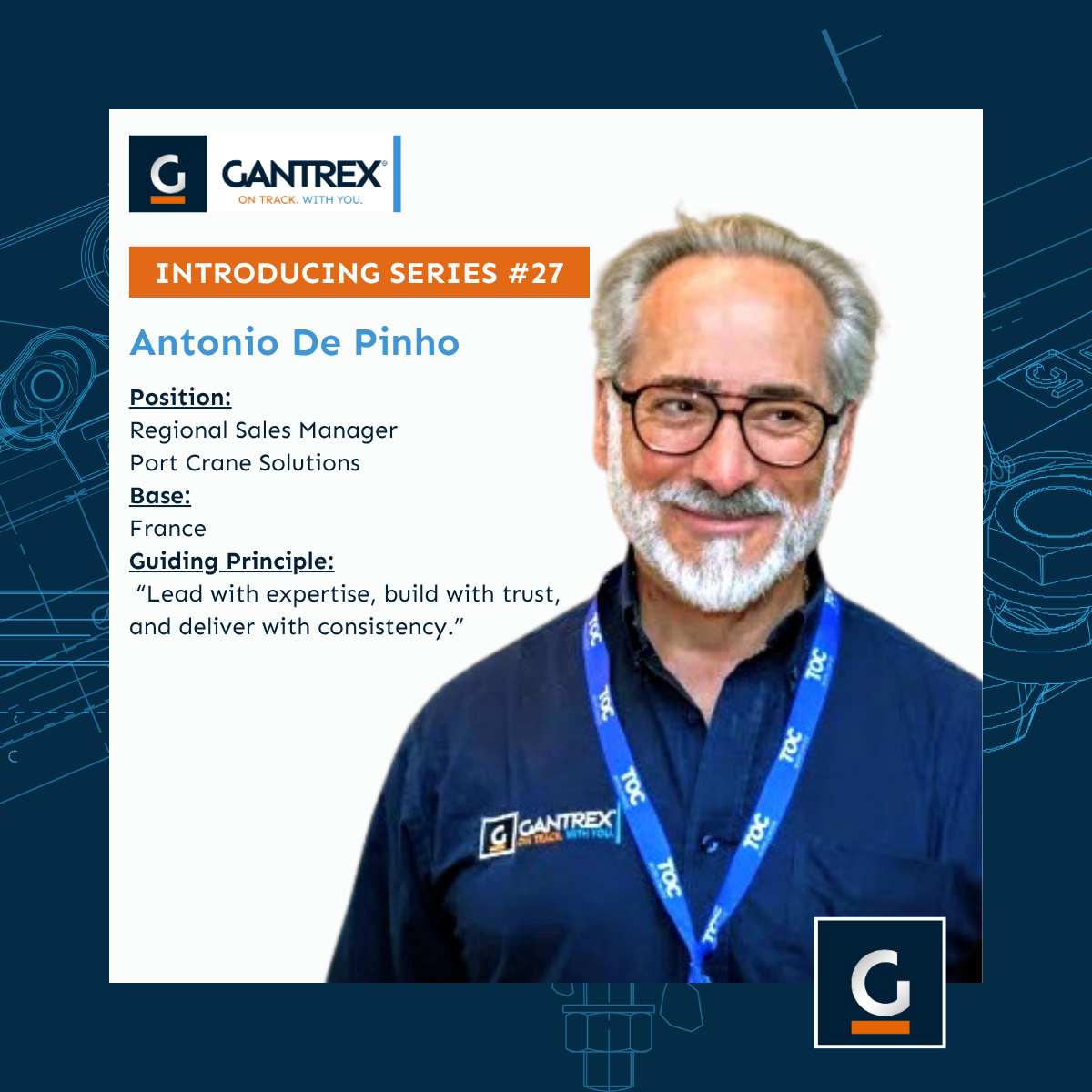
THE GANTREX "INTRODUCING" SERIES #27
Lead with expertise, build with trust, and deliver with consistency
In this edition of our Introducing Series, we speak with Antonio De Pinho, Regional Sales Manager at Gantrex, about his career in port and maritime infrastructure, how he builds long-term relationships and the opportunities he sees emerging in his territories.
You’ve spent more than two decades in port and maritime infrastructure. How has that experience shaped your approach as Regional Sales Manager at Gantrex?
I have spent 22 years working in the field of heavy-duty handling equipment, and more specifically in the port and maritime infrastructure sector, and that experience shapes everything I do today. This role isn’t simply about generating revenue; it’s about managing long-term technical relationships with clients whose operations depend on the solutions we provide. Throughout my career, I’ve worked in project development, technical support and business development across France and French-speaking Africa. Those roles gave me a solid understanding of the realities our clients deal with every day: maintenance challenges, safety concerns and tight budget cycles. That operational insight is probably the most valuable thing I bring to Gantrex.
What was it about Gantrex that made the role the right next step for you. And what continues to motivate you today?
The diversity of our offering. At Gantrex, we don’t just pick a product from a catalogue. When I meet with a port terminal manager, whether in Le Havre or Nouakchott, I offer them a comprehensive solution: rails, fastening systems, technical analyses and, increasingly, inspection technologies such as 3D scanning, vibration monitoring and functional monitoring. I also appreciate the way the company combines a global presence with local knowledge. We can draw on international expertise whilst adapting to the specific realities of each region. This balance is a real asset. You manage a diverse territory across France and North Africa. How do you adapt your relationship-building and technical discussions to different business cultures?
Patience and preparation are key. Across French-speaking Africa, including Morocco, Senegal, Mauritania and the Ivory Coast, relationships come before business. You don’t walk into a meeting and jump straight to the offer. You take the time to understand the organisation, the decision-making structure and the project’s history. I have learnt over the years that it is a mistake to assume the level of technical maturity or knowledge of the teams I am meeting. Some port operators have advanced systems, while others manage ageing infrastructure with limited internal engineering support. I adapt the conversation accordingly. The goal is to be helpful, and convey our expertise, without overwhelming anyone.
Your role requires collaboration across cultures and teams. What principles guide your leadership and ways of working?
Clarity and consistency. A leader should make sure people understand where they’re going and why, then stay aligned with that direction even when it’s challenging. They should also create an environment where people feel able to be honest. If problems stay hidden until they become crises, that’s a leadership issue, not a staff issue. And curiosity matters too. The best leaders I’ve worked with genuinely want to understand what teams are facing day to day.
Customer focus is a recurring theme in your work. How do you translate that into day-to-day behaviours with clients?
For me, it means listening more than talking. When a customer asks a question, I first try to understand the issue behind it, not just to answer the surface-level question. It means I follow up, and yes, sometimes it means responding at the weekend when a client is facing a project deadline. For me, customer focus is less a philosophy than a series of consistent, unobtrusive behaviours that build trust over time. A client who calls me because they have a problem has already paid me a compliment, putting their trust in me and believing I can help them. It’s a responsibility I take seriously.
Based on your interactions across ports and terminals, what do customers value most in their partnership with Gantrex?
Reliability. Customers value this above everything else. They want to know that our Gantrex solution will perform as expected, that delivery dates will be met and that we’ll answer the phone when something needs attention. Operational downtime in ports is expensive, so confidence in our recommendations matters a great deal. Customers also appreciate expertise. When I can explain why a certain rail profile or fastening system suits their exact situation, rather than offering a standard option, the discussion becomes far more meaningful where we are able to showcase the real value that we deliver through our unrivalled expertise.
Looking at your territories, where do you see the most significant opportunities for growth, particularly within Crane Solutions?
We’re seeing a strong pipeline of port expansion across Africa, particularly in the Maghreb, container terminal upgrades in Morocco, port development in Cameroon and Senegal and growth linked to regional trade corridors. Many of these facilities are expanding crane fleets or refurbishing older rail infrastructure, which creates natural opportunities for us. In France, increasing regulatory pressure on lifting equipment is creating demand for inspection and compliance services. Our expertise in inspection technologies such as vibration monitoring and 3D functional monitoring puts us in a strong position in this niche market, both as a standalone service and as a starting point for larger-scale refurbishment projects, including the refurbishment of forklift runways.
What challenges are unique to operating in North Africa, and how does Gantrex’s ‘glocal’ model help you respond to them?
A recurring challenge in Africa is the complexity of procurement with long lead times, import logistics and varying levels of local technical resources. Customers need robust, easy-to-maintain solutions with clear documentation in their working language. This is where our global model really helps. I can rely on the wider group for engineering expertise and product range, while adapting communication, delivery and support locally. I don’t rely on standard solutions; I tailor them for each situation.
Another challenge is the gap that sometimes exists between clients and their maintenance teams. I try to bridge that by offering training and clear technical documentation. This empowers local teams, in the long run, building lasting loyalty and deeper customer relationships.
Can you share a recent project where Gantrex’s expertise made a measurable difference to a customer’s operation?
Recently, a port terminal reported recurring issues with its crane tracks, including accelerated wear, cracking concrete and unplanned downtime. Instead of simply offering replacement parts, we traced the problem back to root causes: load distribution, drainage and the original specifications. We proposed a full refurbishment supported by technical analysis and positioned it as an investment in long-term reliability rather than just a maintenance cost. When you compare the cost of failure to the cost of a durable solution, the conversation changes completely and the decision becomes more straightforward.
As you look ahead to the coming year, which developments or projects are you most excited about?
Services like inspections, 3D scanning and spare parts offered independently are exciting because they allow us to engage much earlier in the decision-making process, often before refurbishment needs are formally identified. I’m also watching the development of African container terminals closely. I think the next 18 to 24 months will bring opportunities for Gantrex to make more of an impact in markets where we only have a limited presence today.
And on a more personal level, I really do enjoy building a territory for the long term. Seeing relationships evolve into repeat business and recommendations is what makes the work truly rewarding, in effect building a legacy for the next generation of sector professionals.
Finally, what advice would you give to someone starting a business development career in this sector?
Start by learning the technical basics. In port infrastructure, clients quickly notice if your knowledge is superficial. You don’t need to be an engineer, but you do need to understand how things work and why your recommendations matter. Be patient. Sales cycles are long and consistency pays off. And above all, be genuinely helpful. Many of my strongest business relationships began when I solved a problem with no expectation of immediate return. It’s simply the right way to work.