Rail welding solutions

Providing the best welding method for your specific needs

What is rail welding?

Joning two portions of rail to become one continuous piece where the wheels will be moving along.

There are different rail welding methods, the most widely used are:

Each of these welding methods has its unique benefits and challenges, and the selection of the appropriate method depends on several factors, such as the application, site layout, budget, and project timeline. Gantrex’s experienced team can help you determine the best welding method for your specific needs and ensure that the installation and/or maintenance of your project is completed on time and within budget.


Key facts
  • Appropriate welding method depends on several factors, such as the application, site layout, budget, and project timeline

  • Modern handling equipment requires smooth, continuous rail tracks that must be butt-welded

  • Gantrex’s experienced team can help you determine the best welding method for your specific needs

Rail welding techniques

Modern handling equipment requires smooth, continuous rail tracks that must be butt-welded to avoid shocks at joints and damage to wheels and other mechanical parts. The geometry of DIN 536/1 type rail, for example, does not allow for any other technique to join rails.

Gantrex has proven expertsie in all three major welding methods, on the ground or at height:

  • Enclosed arc (puddle arc) welding
  • Alumino-thermic (thermite) welding
  • Flash butt welding

The chosen technique will depend on site constraints, size of the job or local possibilities and contingencies. Scroll down for information on the technology used, the equipment needed and the implementation of each of these methods.

ENCLOSED ARC WELDING (PUDDLE ARC)

Enclosed arc welding (puddle arc)

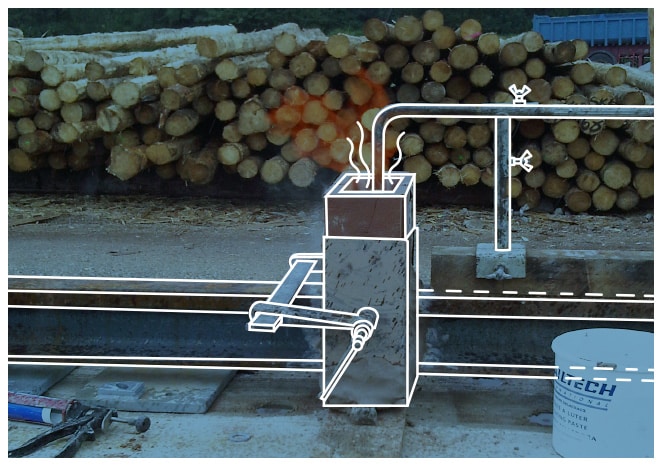
This a popular method for welding rails on site, as it can be performed in all weather conditions. This method uses a consumable electrode that melts to form a weld puddle, which is then covered by a layer of flux to protect the weld from contaminants. The resulting weld is strong, durable, and resistant to corrosion.

Technology

The void between the ends of the rail is filled with a continuous layer of fillet welds.

Equipment

Permanent basic equipment: material for adjustment and preheating, a set of electrolytic copper blocks, power transformer and grinding equipment.

Consumables: specially adapted electrodes and heat insulation plates to protect the pad.

Implementation 

The technique requires qualified rail welders.

Contact us for more information about our welding solutions and services
alluminothermic welding

Aluminothermic welding

Also known as thermite welding, is a commonly used method for joining rails. This method creates a chemical reaction between aluminum powder and iron oxide, which produces molten steel that is used to weld the rails. Aluminothermic welding is known for its high strength, durability, and ability to withstand extreme temperatures and heavy loads.

Technology

The steel obtained by combining iron oxide with aluminum is cast at over 2000°C in a refractory mould matching the rail profile.

Equipment

Permanent basic equipment for thermite welding: material for adjustment, mould fixing, preheating, casting and finishing off.

Consumables: mould adapted to the rail profile, welding charge and an igniter.

Implementation

This technique gives excellent results, and is independent of atmospheric and operational conditions.

The implementation of this thermite welding technique requires qualified welders. Gantrex can provide you with the necessary training and qualification for your welders, or we can carry out the welding operation on your behalf.

Contact us for more information about our welding solutions and services

flash butt welding

Flash butt welding

This a technique used for joining two rail ends together without any foreign material. This method involves using a specialized welding machine to accurately join the rail together, the process is very time efficient but requires large diesel engine and a specialized machine which increases the setup costs. Flush butt welding results in a smooth, continuous rail, making it ideal for big rail system projects.

Technology

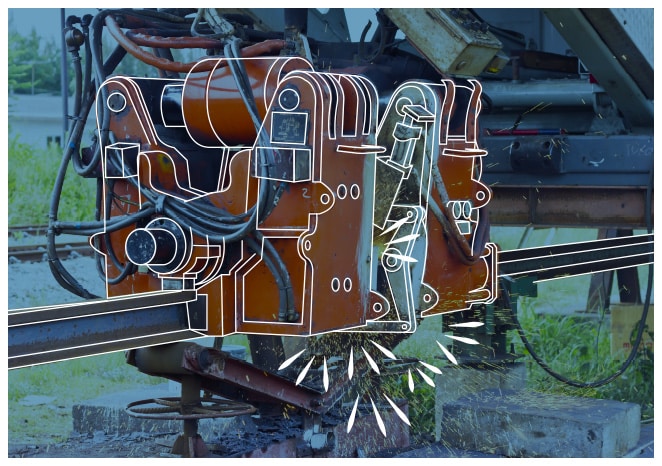
The flash butt welding process involves bringing the rail ends together and generating an arc which heats the metal. Once the metal reaches the appropriate temperature the rail ends are forged together using hydraulic pressure and the excess upset material at the weld interface is sheared away to produce a near perfect rail profile with minimal secondary profile grinding required. The entire process is automated with the rail ends encapsulated and manipulated by a portable weld head.

Equipment

The support equipment which provides power and control to the flash butt weld head is truck-mounted and connects to the weld head with umbilical cables and hoses. The support vehicle must be able to get close to the welded site. For overhead welding, at least two mobile cranes are required to support the welding operations. One to support the weld head and the second to lift and place the rails.

Implementation

The process lends itself to very high weld production rates but only if the supporting labor force is well organized to take full advantage of the equipment capabilities. The process is most productive when the rail is fed to the weld head at a fixed location, welded then pulled down the runway on rollers. We are able to provide guidance and management of the flash butt welding process to maximize your productivity.

Find out more about our Flash Butt welding services

Related Video

Driving excellence & innovation through collaborative partnerships

siemens logo
swisslog logo
schaffer logo

Documents Downloads

Discover all the related documents available for download, including detailed technical data sheets, brochures, and other useful resources.

Ready to take the next step? Get in touch now!

Whether you need one of our products or a service, our more than 500 dedicated Gantrex experts and 20 local offices are looking forward to knowing more about your needs and provide the right solution.